
In continuation of my earlier post — SAF-T (NO) Configuration with Enhanced Performance – DynFOTech— I have expanded the solution with a dedicated GitHub project that addresses an increasingly common challenge in Dynamics 365 Finance:
Slow loading of Application-specific parameters in SAF-T (NO).
You can find the full project here:
👉 https://github.com/Alireza-Eshaghzadeh/DynFOTech-SAF-T-NO
This repository minimizes load time for mapping pages such as VAT Code Mapping, dramatically improving the user experience when working with large datasets.
In this new article, I’ll cover two major areas:
- Recent updates from Microsoft that significantly reduce the risk of time‑outs during SAF‑T (NO) generation.
- Extended improvements delivered through the DynFOTech SAF‑T NO project, including smarter file naming, traceability enhancements, and automated CID cleanup.
1. Microsoft Updates: Reduced Time‑Outs in SAF‑T Generation
With Microsoft’s SAF‑T format version 190.180, several core components of the standard SAF‑T generation process were optimized to reduce performance bottlenecks. These improvements directly address issues customers previously reported when running SAF‑T on:
- Correction to main account balance calculations in the SAF-T report for Norway (Issue 1049075)
- Optimized logic for generating
<GeneralLedgerEntries>, resolving performance bottlenecks that previously caused timeouts during generation (Issue 1077940)
These improvements significantly enhance the export generation phase. However, many organizations continued to experience performance challenges before generation—specifically when loading Application-specific parameters.
This is where the DynFOTech extensions provide additional value.
2. Extended DynFOTech Improvements (Version 190.180)
The GitHub project introduces an extended ER format built on top of Microsoft’s standard SAF-T configuration. This extended version delivers practical enhancements requested by customers working with large mapping tables, recurring exports, and strict validation requirements.
New Artifact
- Format: SAF‑T Format (NO) – DFT Extended (190.180)
Below are the key enhancements included in this extended configuration.
2.1 Faster Application‑Specific Parameter Loading
One of the most common pain points with SAF-T (NO) is the time required to load Application-specific parameters for:
- VAT Code Mapping
- Account Mapping
The extended format optimizes this area by reducing unnecessary recalculations and minimizing UI overhead, resulting in noticeably faster load times and improved usability.
2.2 Smarter SAF‑T ZIP File Naming for Better Traceability
The standard SAF-T ZIP filename often makes it difficult to identify the reporting period—especially in environments with multiple legal entities and frequent exports.
The extended version automatically injects the start and end date/time into the ZIP filename, providing immediate traceability without the need to open the XML file to determine the reporting period.
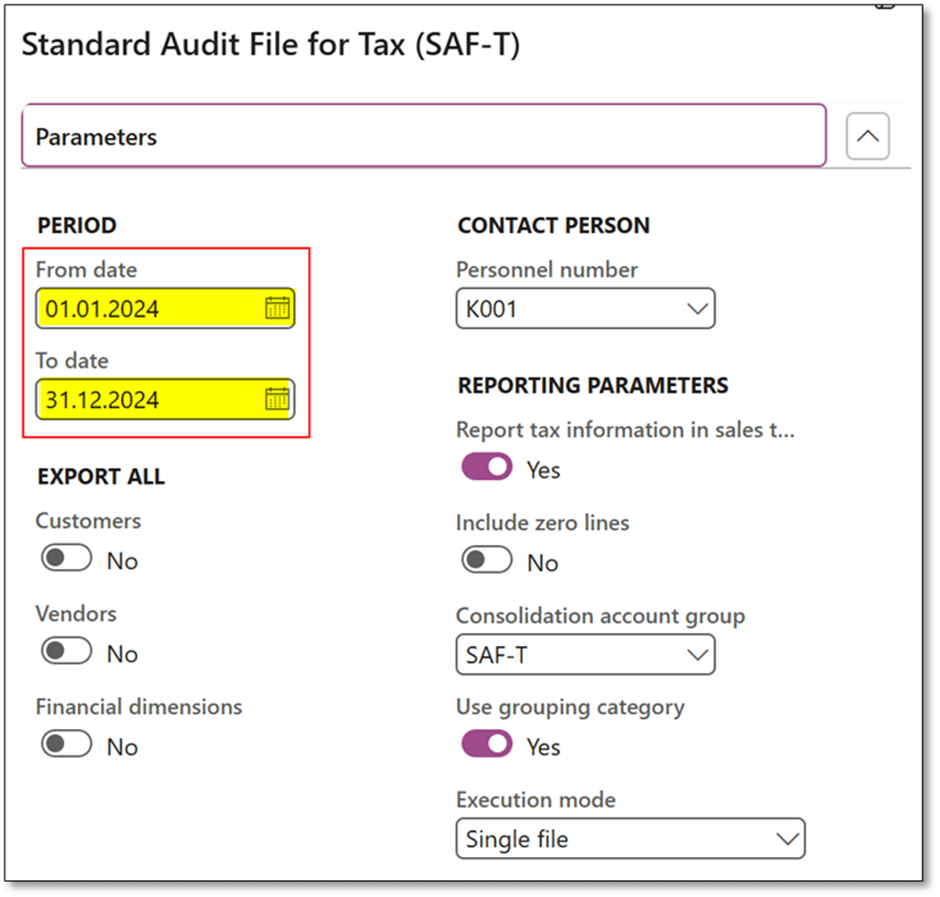

2.3 Automatic Cleanup of Invalid Characters in CID
Many organizations encounter SAF-T validation failures due to Payment ID (CID) values containing non-compliant characters.
The extended format includes logic to automatically:
- Remove invalid symbols
- Strip unnecessary whitespace
- Normalize special characters
Outcome:
- Cleaner CID values
- Reduced validation errors
- Fewer rejected SAF-T submissions
Why Use the Extended SAF-T Version?
The DynFOTech SAF-T (NO) extended format is particularly beneficial for organizations that:
- Work with large VAT and account mapping tables
- Perform multiple SAF-T exports per period
- Have experienced timeouts during SAF-T generation
- Require clearer file naming for operational control and auditability
- Need consistent and compliant CID values to avoid validation failures
If any of these scenarios apply to your environment, the extended format can significantly enhance your SAF-T reporting experience.
Final Thoughts
With Microsoft’s latest improvements addressing timeout issues during SAF-T (NO) generation, and the DynFOTech extensions focusing on performance, traceability, and data quality, organizations can now execute SAF-T reporting more reliably and efficiently than ever before.
All enhancements are available here:
👉 https://github.com/Alireza-Eshaghzadeh/DynFOTech-SAF-T-NO
Feel free to use the project, and let me know if you are interested in contributing—community-driven improvements make the Dynamics 365 ecosystem stronger.
If you find the project useful, please ⭐ the GitHub repository and share your feedback.
 DynFOTech